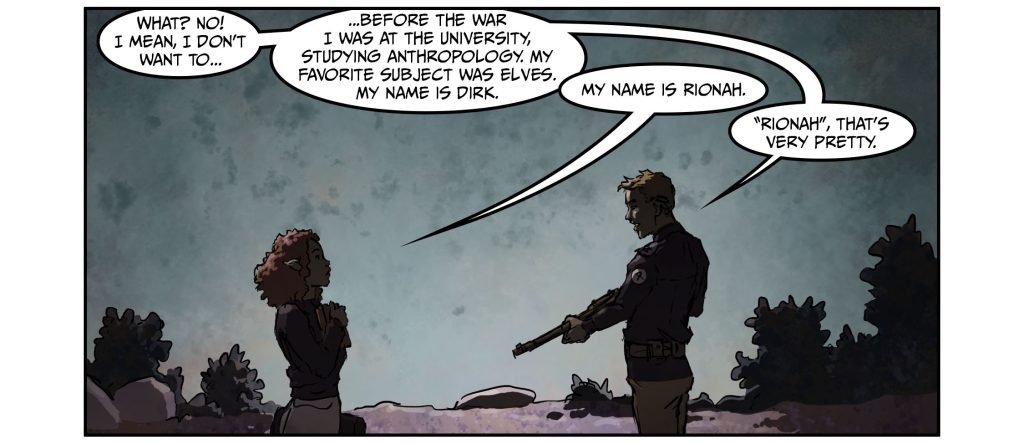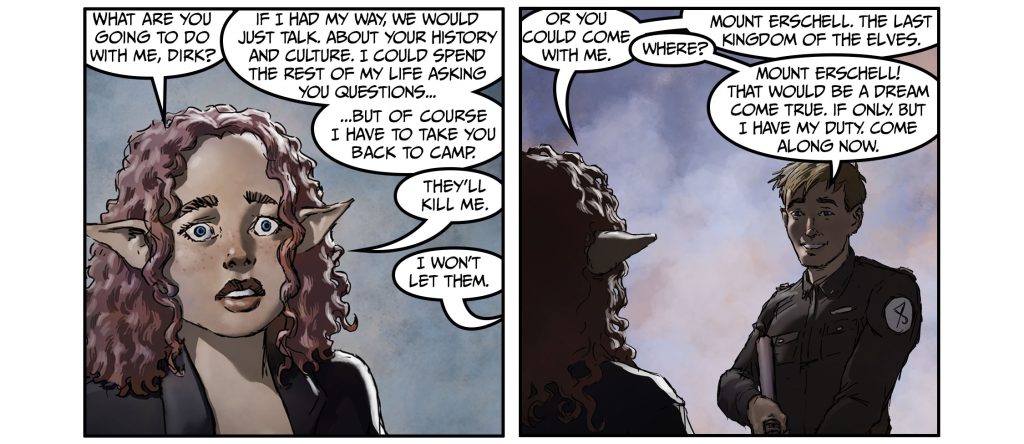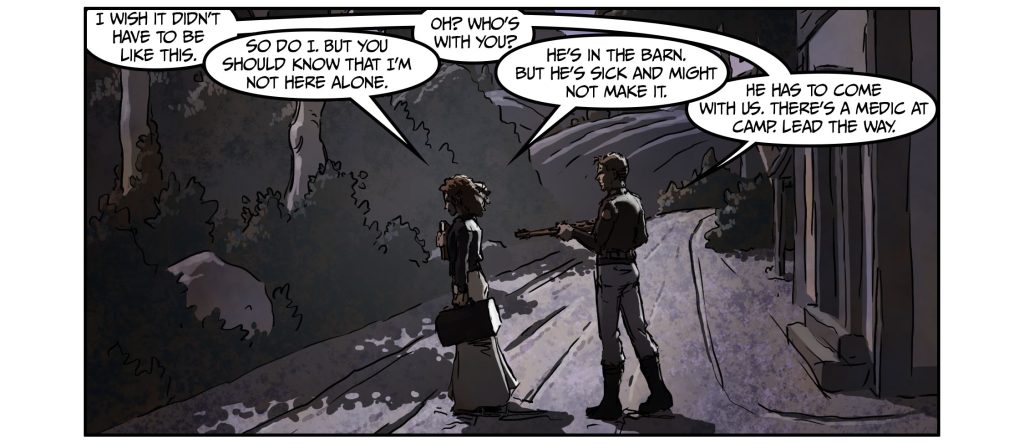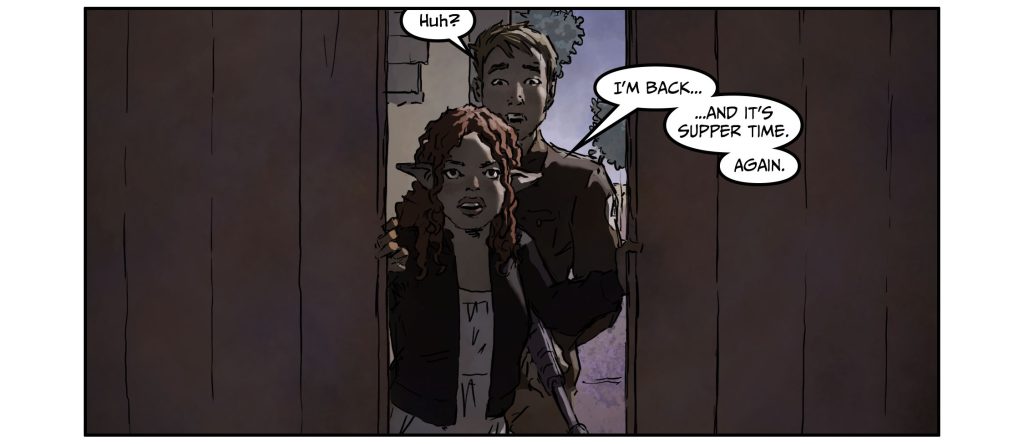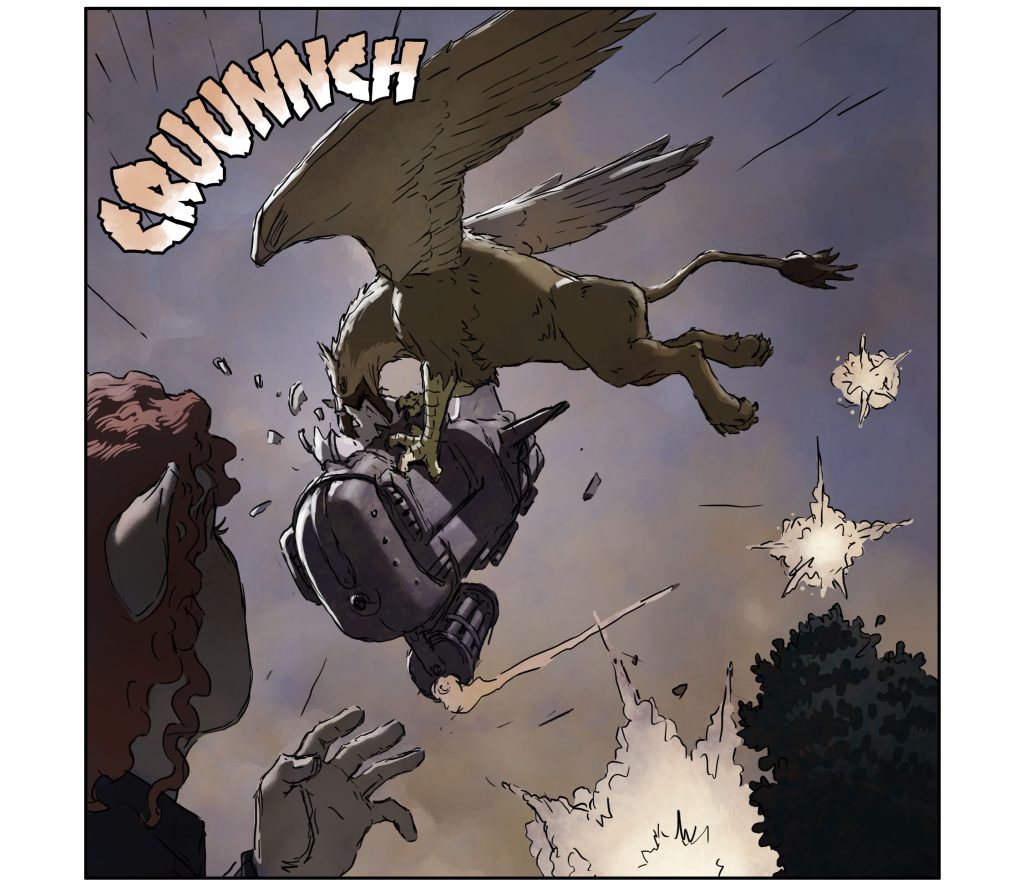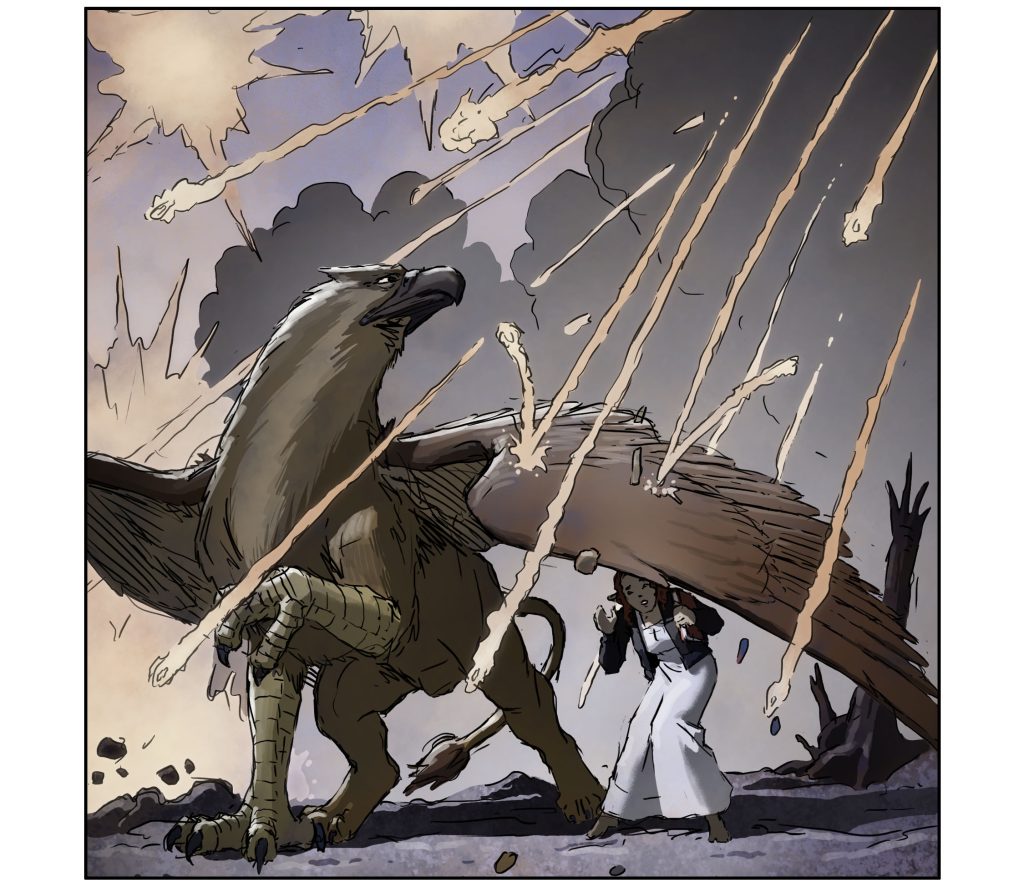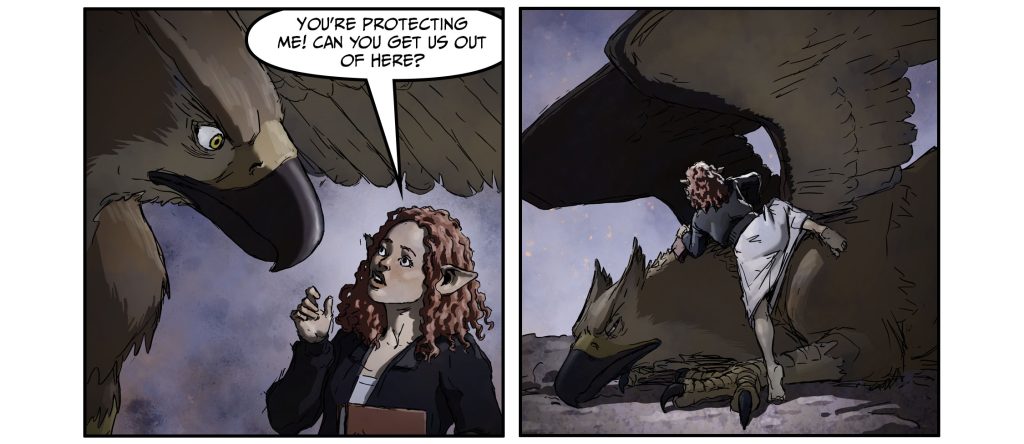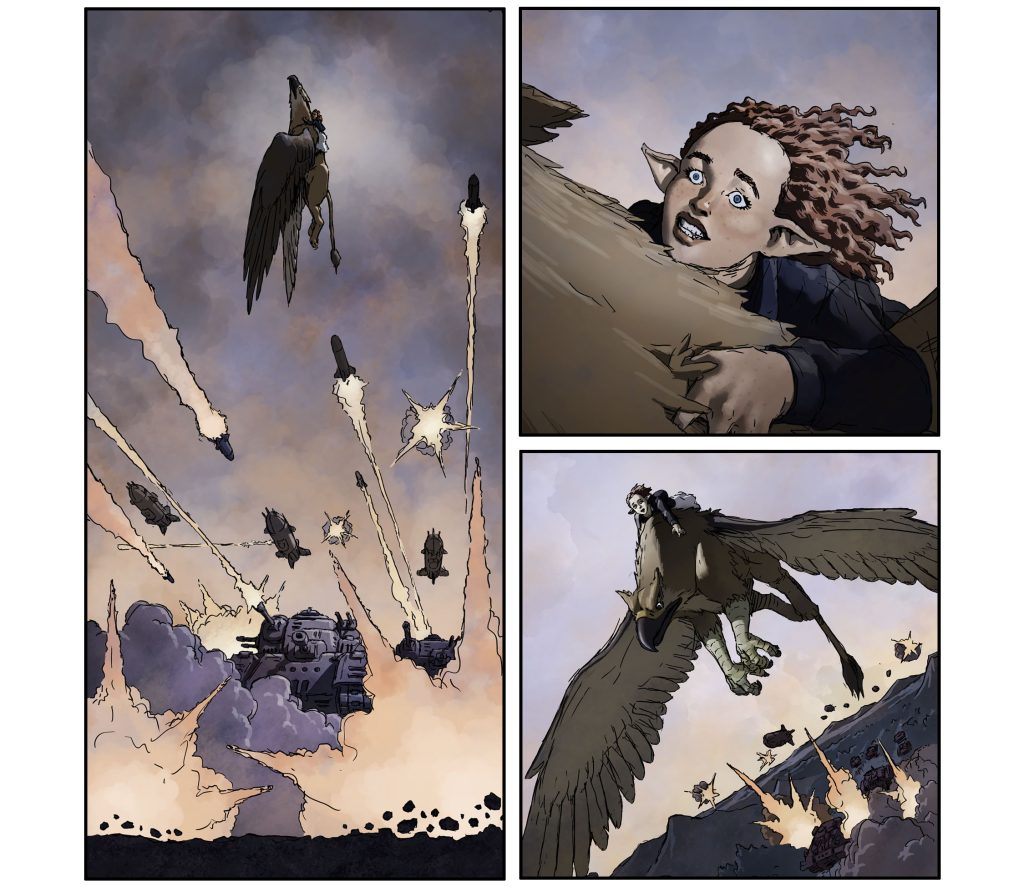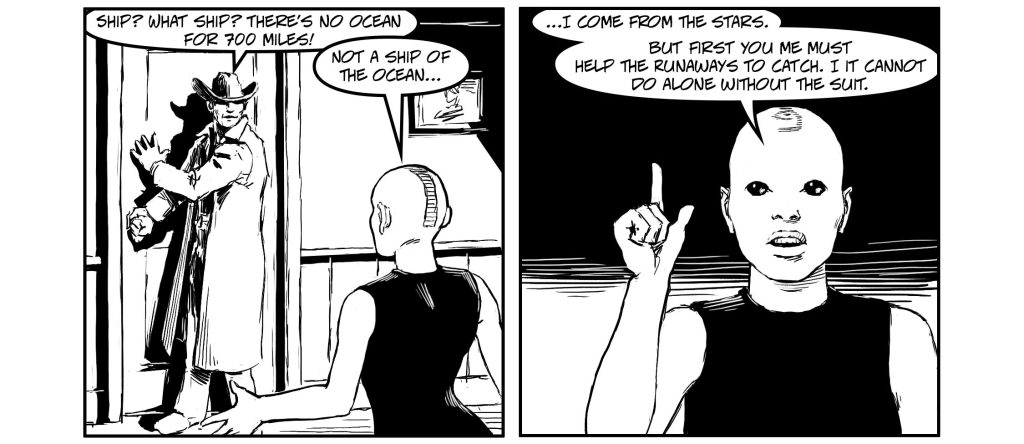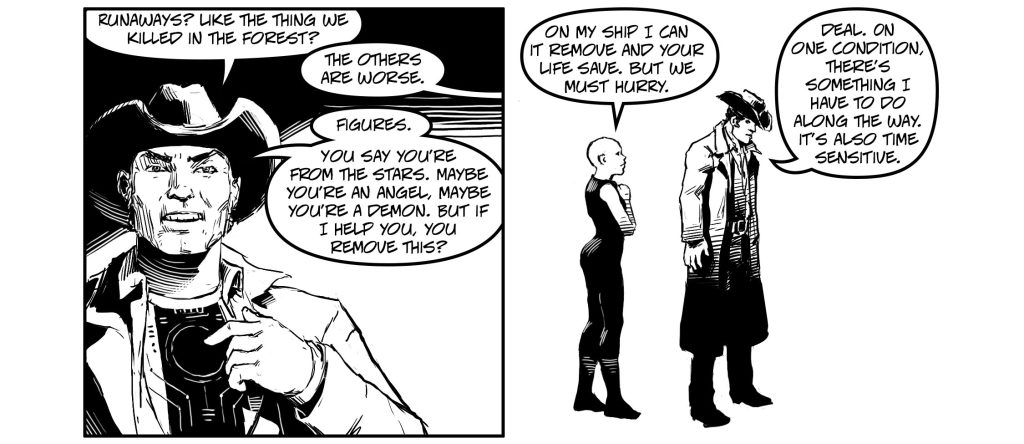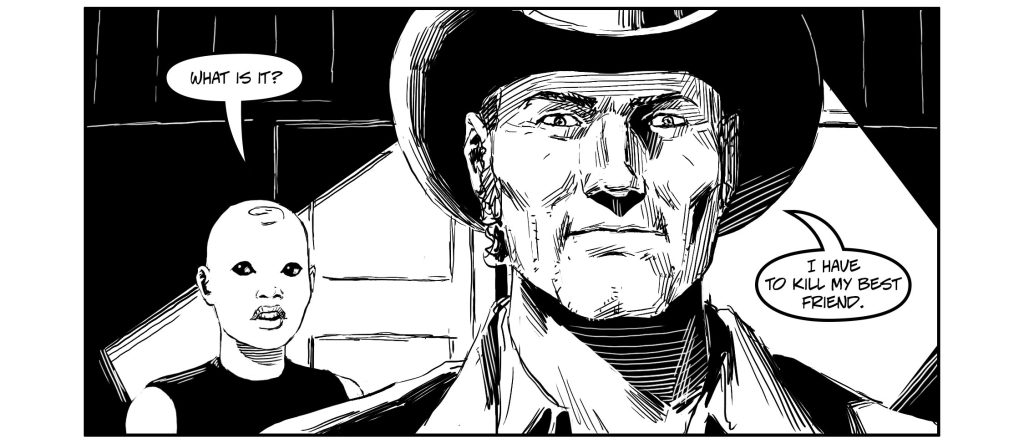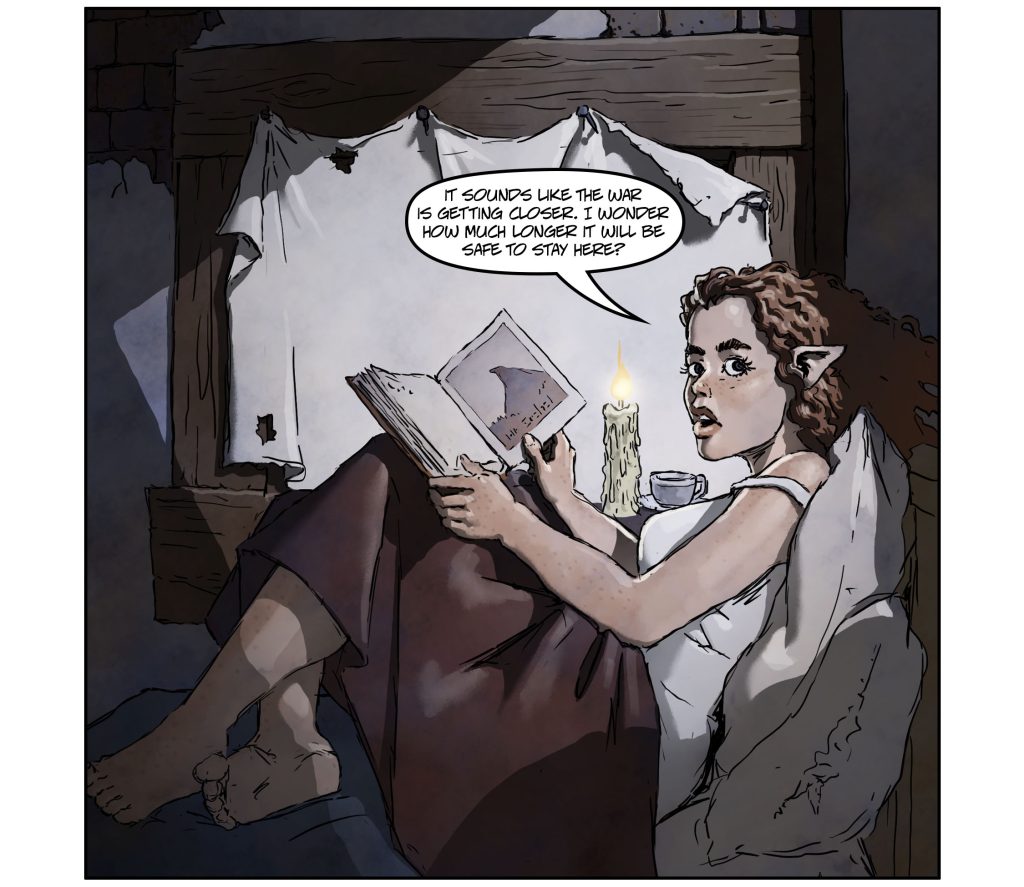
Red Outlaw and Wandering Star
By Doug Lefler
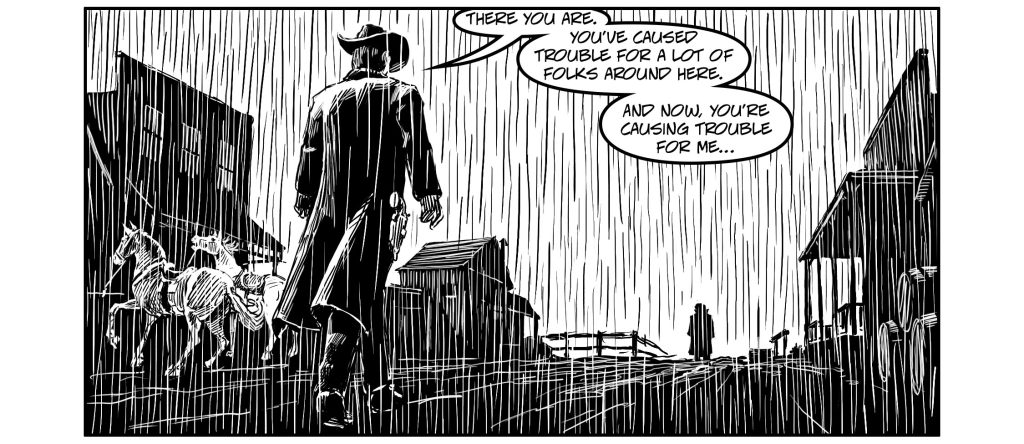
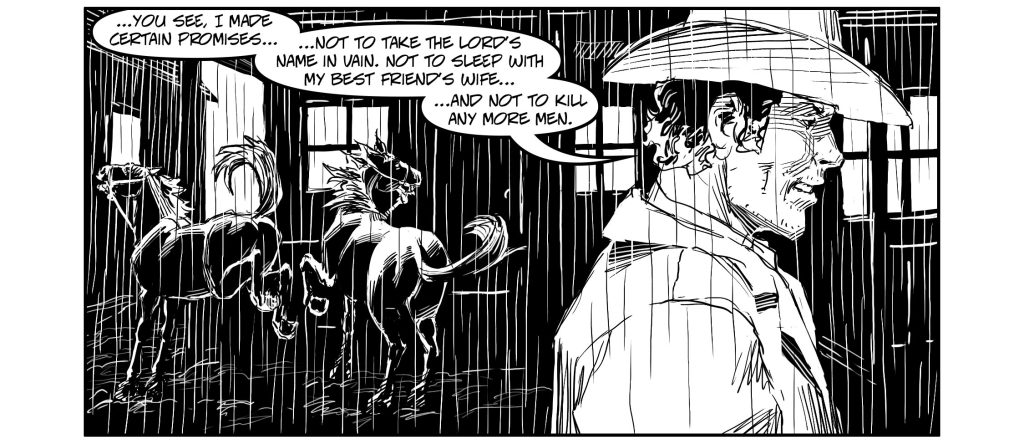
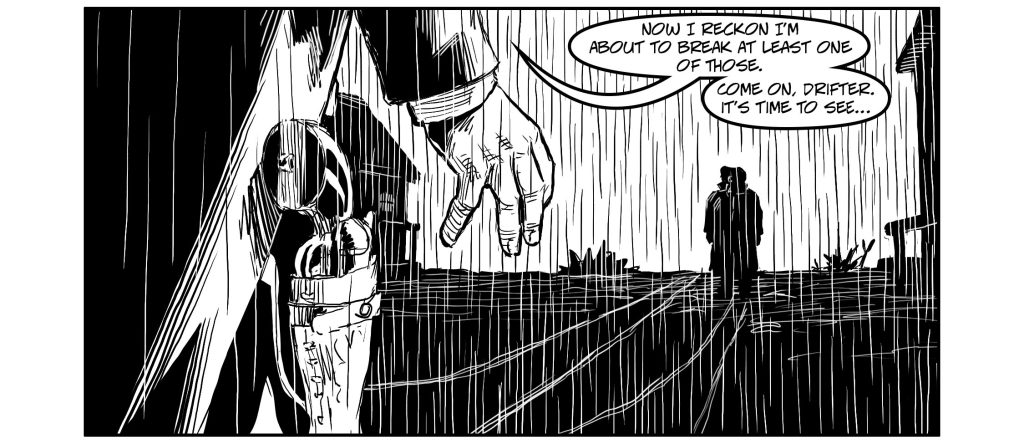
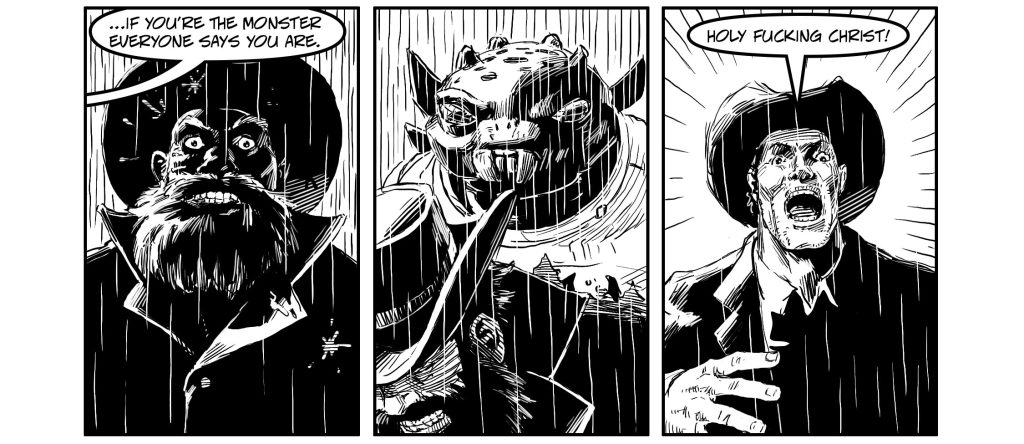


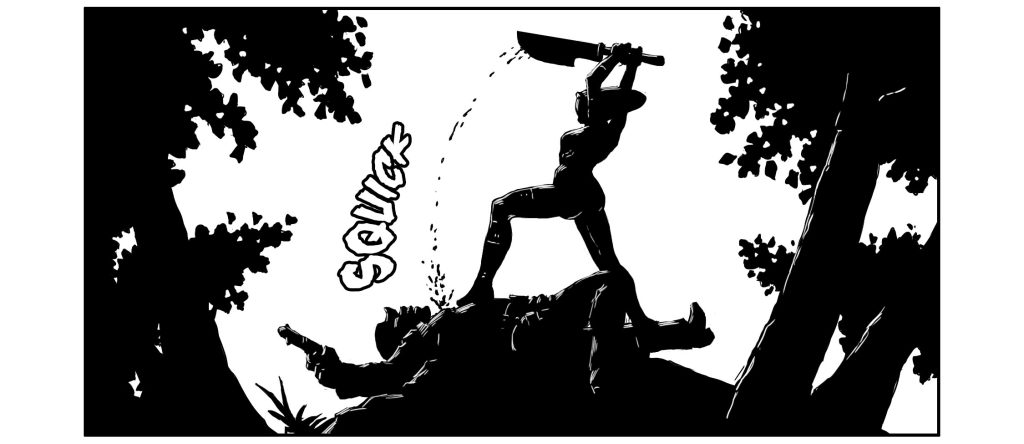
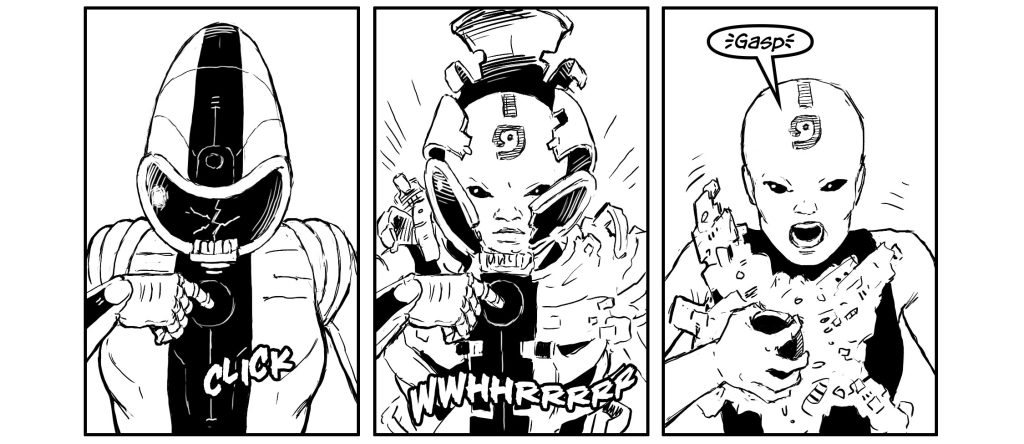
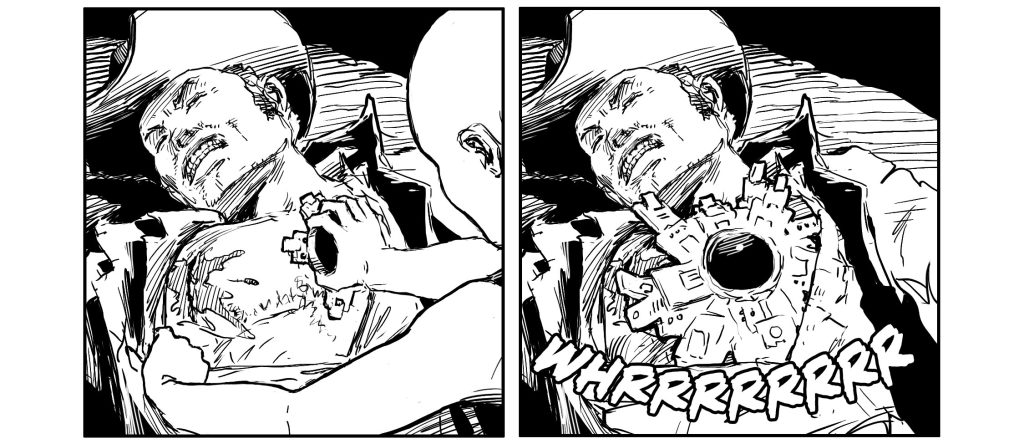

Read PART TWO.
Once More In Hammer Clash
By Doug Lefler
1
The few records that survived the sacking of Fergibben suggest that the renowned sword maker Turchier was an arrogant ass. Not wanting another’s work to surpass his own, Turchier refused to teach his metallurgic techniques to anyone, including his apprentice, who was his son. As a result, most of his artistry was lost, scattered, or melted with the kingdom’s fall.
One of the few blades known to have survived came into the possession of King Kushyr with its hilt damaged when someone had stripped it of the inlaid gold and set gemstones. Kushyr was a monarch who valued elegance over ostentatiousness, so he had the weapon repaired with a single piece of silver that arched from the guard to the pommel in the shape of a treble cleft. The blade was named simply the Turchier Sword and never left the king’s side until the Night of the Red Knives.
It is still a mystery how King Kushyr and his only daughter survived the coup and assassination of most nobles and the Royal Guards. However, an unnamed scholar was visiting the castle at the time and influenced the events of that bloody night. The following day, one reliable source reported that after the scholar refused Kushyr’s offer of the princess’s hand in marriage, the king gifted him the Turchier Sword.
It was an opportunity that would not present itself a second time.
“What you’re going to do, children,” Guntry proclaimed. “Is both of you pick one item from the store.”
Lisyl and Bowden’s eyes were open in wonderment at the bounty surrounding them in Bradylstock’s Curiosity Emporium.
“And you’ll buy it for us?” Bowden asked. At six years old, he did most of the talking for himself and his younger sister.
Guntry nodded, “To remember your trip to Hammer Clash.”
They were standing amid a kaleidoscopic collection of merchandise from the mundane to the marvelous. Baskets, beads, baubles, puzzle boxes, and folding knives shared shelf space with gauntlets and helmets pock-marked from bygone wars. A unicorn’s skull with a horn that looked suspiciously like bleached birchwood was on a pedestal in the corner. From the rafters hung butterfly nets and ghost lanterns. Barrels of buttons, hooks, buckles, and fasteners cluttered the floor. The label on a jar behind the counter advertised its glittering contents as mermaid scales.
“What’s that?” asked Lisyl, pointing at something resembling an artificial flower on a stick.
“That, young lady,” said Bradylstock, the rotund proprietor of the store, “is a pin-wheel made from pixie wings.” He lifted the item from its stand with exaggerated caution and handed it to the four-year-old girl.
“Can I see the puppet on that high shelf?” asked Bowden as he hopped from side to side in his excitement. Guntry smiled. The joys of children can make the most formidable men young again.
“I hope you’ll bribe me with gifts as you do with my little ones.” Mila stepped beside Guntry and hooked her arm in his. “You don’t get them without marrying me.”
“For you,” Guntry pulled the woman closer. “Two items from the store.”
Guntry was a man accustomed to victory but was surprised that he had won Mila. She had her children late in life, but at forty-five years, Mila was still ten years younger than Guntry. Raising a boy and girl alone had not accelerated her aging nor dulled the brightness of her eyes. And although her dark hair showed insipient grey, it was in balanced and harmonious streaks as if an artist had applied them with loving brushstrokes. Guntry’s wavy curls were a memory, but his bald head and the diagonal scar over his left eye could not detract from the squared-jawed ruggedness of his looks. In his mid-fifties, he was lean and muscular in a way that younger men envied.
Mila lowered her voice to a conspiratorial level. “Most items in this shop are nonsense, but not everything.” She raised a small bottle and held it to the light from the partition window. “It’s Mungwa Nut oil! Very useful to an Alchemist. It’s probably the rarest thing here.”
“No,” Guntry said, his eyes locked on something across the jumbled room. “It’s not.”
He disengaged Mila’s arm from his and approached the counter. The shopkeeper was handing a puppet to Bowden when Guntry gestured toward a sword mounted on the arch overhead. The tarnished silver of the weapon’s guard resembled a treble cleft that arched gracefully to the pommel.
“That sword,” Guntry demanded. “Where did you get it?”
Bradylstock smiled like a fox. He might be able to close early with a full till. “Ah, sir, you have an eye for good steel.” The shopkeeper took down the sword. “Would you care to see it up close?”
“I have seen it close,” Guntry’s avuncular air had dissipated; his eyes were cold. “Where did you get it?”
“A local man sold it to me,” Bradylstock said, resting the blade on his open palms. “He didn’t say where he got it, and I didn’t ask.”
Guntry took the sword by the handle. His other hand reached for his coin pouch. “A local man? Describe him to me.”
“A nose like a hawk’s beak, large ears….” Bradylstock picked his words judiciously. “…Very well mannered. Tall. Lank. Wears clothes that would embarrass a scarecrow. I think he’s a scholar.”
“What you’re going to do is stay in the middle of the caravan and keep the children close. I’ll join you tomorrow.”
Sunlight in the busy Hammer Clash town square was aggressive after the diffused light inside the Curiosity Emporium. The cries of gulls and the smell of saltwater were prevalent. Guntry cinched tight the ropes securing the travel chests to their wagon, one of many family-owned carts and wagons preparing to depart. Homesteaders looking for a new life in the Rigdon Valley preferred to journey in large groups. “
“Let’s discuss this,” replied Mila in a measured voice that she usually reserved for her six-year-old. “What is the story behind that sword? You didn’t even barter with the man when you bought it.”
Guntry held the Turchier Sword reverently. “That fool of a shopkeeper has no idea what he had. This sword is worth more than all of Hammer Clash, although I would never sell it. I must return it to its owner.” Here he frowned in vexation. “He cannot discard it like that!”
“Obviously, you have a history with this man,” Mila calmly reasoned. “And with this weapon–“
“This weapon,” Guntry said, pointing to the pale ridge of flesh in a diagonal line over his left eye. “Gave me this scar.”
“I know you have a violent past, but you promised me that part of your life was over. So please tell me that you are not after revenge.”
“Revenge?” Guntry smiled and met her eyes. “Revenge is a young man’s folly. Trust me when I tell you that I have nothing but respect for the owner of this sword. There is no man alive that I respect more.”
“Who is he?”
“His name….” Guntry reached into his memories, “….is Artagan of Lux.”
The boy ran to keep pace with his lank, long-legged master. He preferred to stay behind and watch from their second-floor window as the caravan left town for the Rigdon Valley. Strangers in Hammer Clash were infrequent, thus the source of wonderment and diversion. But the boy recognized that his teacher’s business was urgent. Why else would he be taking a shortcut through the fish market? And why had he spent most of the night composing the letter he now carried in his boney hand? The scholar often surprised the boy with his ability to segue from languidness to hyperactivity without warning. Even so, the ten-year-old boy adored him.
They were just past the net weavers’ stall when the scholar abruptly halted. The boy skidded to a stop beside him. His master put a hand on his shoulder, ostensibly so that the older man could steady himself, but the boy recognized that the gesture was protective. Danger was present.
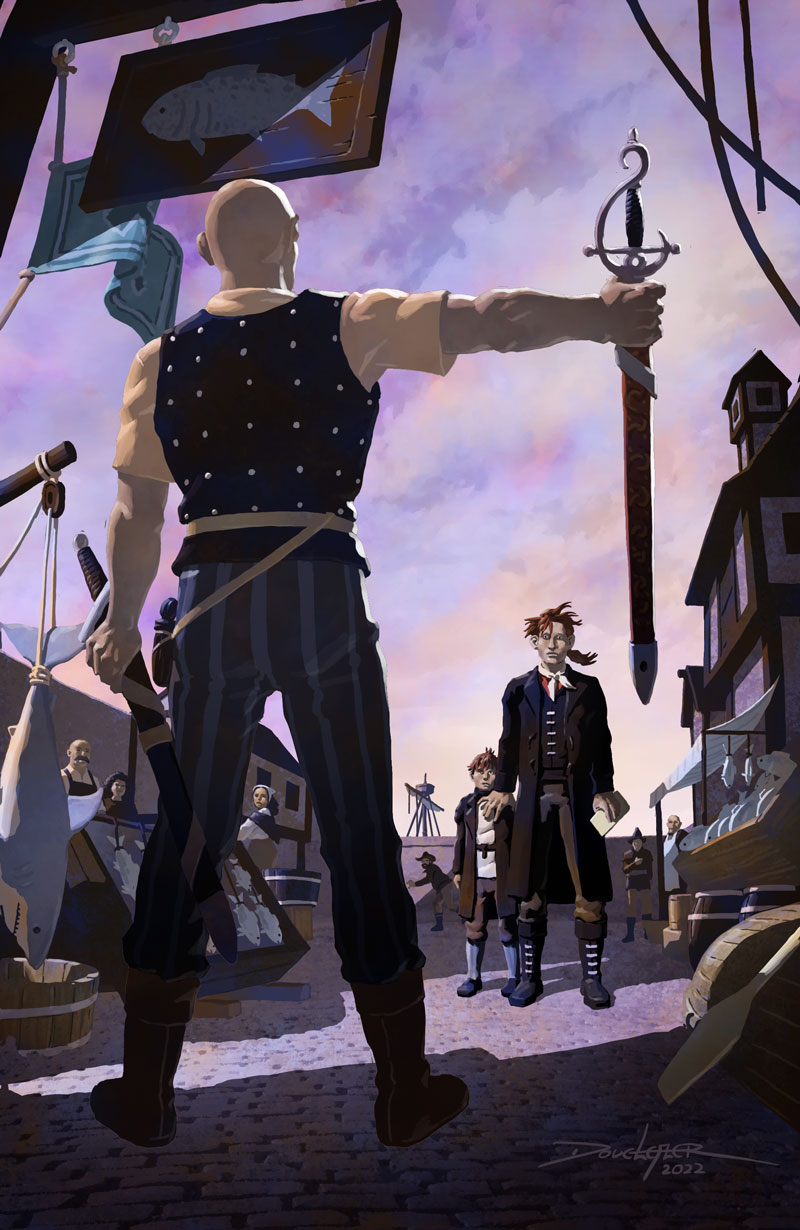
A man held a sword on the other side of the market square. He was roughly the same age as the scholar but a few inches shorter, lean, and muscular, with a bald head and a scar over his left eye.
“Good morning,” the man said.
“Guntry?” the taller man asked.
“Artagan,” Guntry replied by way of greeting. “You got old.”
“Maybe. But I still have my hair.”
Guntry ignored the slight. He motioned towards the boy. “And this? Your son?”
“My ward,” the scholar replied. “This is Noak. An orphan,” here he addressed the boy. “Noak, this man is Guntry Galladen of Kettridge.”
The boy’s interest was invigorated. “Guntry Galladen,” he repeated. “Of the Battle of Eagle Pass and the Seige of Tomblyn Hold?” He turned to address the stranger. “You’re an assassin, aren’t you?”
“Professional duelist,” Guntry corrected. “I’ve never killed a man when I wasn’t looking him in the eye.”
“Guntry is the most skilled swordsman alive,” Artagan informed the boy.
“And your master is the most cunning swordsman.”
“If you’ve come for a fight, I cannot oblige you,” Artagan lifted his hands, palms facing forward. “I’m unarmed.”
Something arched through the air, thrown by Guntry. The Turchier Sword landed on the cobblestones at the scholar’s feet.
“How could you sell it?” Guntry demanded.
Artagan sighed. Suddenly he looked older than his fifty-five years. “I did not think I would be needing it anymore.”
Guntry began to pace sideways around the square. The people scattered about the market noticed the incident unfolding near them. A woman with a dirty apron ushered her three children towards the gate that led to the shipbuilders’ yard while three fishmongers decided to close their stalls.
“When I first saw your master,” the professional duelist still talked to the boy. “He was standing over the bodies of ten men sent to kill him by the Duke of Kompt. The Duke didn’t like his friendship with Lady Gisella.”
“Those men were ruffians and brawlers. They barely knew which end of the sword was pointed,” Artagan dismissed the story. “You could’ve taken them without breaking a sweat.”
“And last week,” Guntry continued. “The Duke died, leaving Duchess Gisella suddenly available.”
“Her ship sails from Hammer Clash harbor within the hour.” Artagan’s words took on urgency. “And I must see her one last time. I heard you were about to get married.” He pointed to the sword on the cobblestones. “Take the sword. Sell it back to King Kushyr and buy your new wife a large farm or a small castle.”
“I don’t want a castle. All that I ever wanted in life was to be the best. Only one person ever made me question that position. Only one itch I couldn’t scratch,” Guntry stopped pacing and drew the sword sheathed on his back. “Now, I have a second chance at happiness.”
Artagan shook his head. “Men like us don’t get a second chance. Men like us die alone, usually clutching a sword wound to the belly.” The scholar handed his letter to the boy. “Here, Noak. Go to the dock. Delay the ship’s departure if you can but make certain that you get this letter into the Duchess’ hands. Do you understand?”
“Yes, master.”
“Go!”
Noak took the letter, ran past the professional duelist, and out the Shipyard gates.
Guntry watched him go. There was something about the boy that puzzled him. “You expect a child to delay the departure of a Duke’s Merchant Ship?”
Artagan picked up the Turchier Sword. “That child is a clever and resourceful young man.”
2
Everyone in Lux believed destiny intended more for Gisella than life in their mid-plains village could provide. And though her father’s opinion of her prospects was limited to an advantageous marriage, Gisella was more interested in higher education. So she often exchanged books and conversations with the tall, gangly kid next door, whose appetite for learning was as voracious as hers. Over time Gisella developed a genuine and lasting friendship with Artagan; he was the big brother she never had.
Lux was the summer home for the Zagboriens. They owned an estate on the west river that boasted an expansive library. The Zagboriens made this open to the public when they were not in residence. It was not a lending library, but locals were welcome to read in the comfort of the library’s atrium. Gissella and Artagan spent so many hours reading together that her father grew suspicious. He was the first man who took steps to limit Artagan’s access to his daughter, but he would not be the last.
For his part, Artagan knew he wanted to be near Gisella for the rest of his life. However, his lack of prestige, money, and looks made it clear that marriage was beyond his reach. It is unclear precisely when or how he conceived of becoming her protector, but there was a respected fencing master in their modest village. In exchange for tutoring both of this man’s dim-witted sons, Artagan received private lessons. Lacking strength and natural athleticism, the tall boy knew he would have to train harder and fight smarter than anyone else.
“Captain Barkyn?”
The tall, weathered man reviewing a manifest turned his head at the sound of his name and then looked down to see the ten-year-old boy. Behind Captain Barkyn was the Fortunes Song, a three-mast Schooner that was the pride of the Duke’s fleet. The ship seldom docked in the harbor at Hammer Clash, but with the death of the Duke, it came to fetch Duchess Gisella back from Hammer Rock Abbey. Along with its illustrious passenger, the ship would return to Regal Port with a full payload of sundries.
“What do you want?” Barkyn grunted in the general direction of the boy.
“Captain Barkyn of the Moon Bay Conflict?” The child’s eyes brimmed with amazement. “And Half Throne, and the Battle of the Tonker Navy? That Captain Barkyn?”
The venerable seaman had little use for children, but he was surprised to hear this one list some of his most notable career accomplishments.
“I know my own name, boy. Who are you?”
Noak snapped upright with a convincing display of embarrassment.
“Apologies, Sir,” he begged. “My master sends his compliments. I have a letter for the Duchess and instructions to put it in her hands personally.”
“Do you now? And who might your master be?”
The boy’s glance flitted to the deck of the Schooner. He glimpsed a woman in a yellow and cream dress accompanied by a handmaiden in blue. They passed through a quarter-deck door leading to the ship’s stern. Noak knew that would be the Captain’s cabin, but naval protocol would dictate that he relinquish his quarters to such an important guest. It was the Duchess.
“The honorable Mr. DeSalgo of Tork.” Noak responded. He had a good memory of important names. “I was given to understand that you know him.”
“Not personally.” The Captain frowned at the boy. “You seem young to be running errands for the Secretary of the Admiralty.”
“I’m his son,” Noak answered with a show of modesty. “May I go aboard?”
Barkyn held up his hand to pause the boy while he bellowed over his shoulder. “Mr. Logan! Where’s my shipment of brandy?”
“Be here in five minutes, Cap’n,” the First Mate called down from the foredeck of the Fortunes Song.
“I want it loaded and stored in ten. We cast off in fifteen.”
“Aye, aye, Cap’n.”
Barkyn gave his attention back to the ship’s manifest in his hand. “I had the pleasure of dining at the Secretary’s house last year. It was a large gathering, and unfortunately, I didn’t speak with Mr. DeSalgo directly, but I was introduced to his children. Two lovely girls. Which one are you, Gretchen or Lucinda?”
Noak froze.
“You’d best let me see that letter, boy.” The Captain extended his hand.
“Damn!” Noak said. He turned and ran.
Steel clanged against steal.
Artagan was breathing hard, and his footwork faltered. Guntry backed him into the market corner, where they stacked barrels of unsold fish on a rack against the wall.
“What happened to you after the Battle of Eagle Pass?” Guntry inquired. There was no hint of perspiration on his brow. He had not made a miss-step, and his breathing was as steady as if they were chatting over tea. “I came looking for you in the infirmary tent.”
“So you could get your rematch?” Artagan asked as he felt Guntry’s blade slice the fabric of his sleeve, missing the deltoid muscle by a quarter of an inch.
“Believe it or not,” Guntry said. “I was concerned about you. We had just won a war together.”
“I thought distracting an opponent with idle conversation was my stratagem,” the tall man wheezed as he took two more shuffling steps back to regain his balance.
“Just trying to put you at ease.”
“It isn’t working.”
Guntry relented his attack, giving the other man time to mop sweat from his brow with his torn sleeve. “A bit out of practice, are you?” Guntry observed with disappointment.
“I suppose you still train every morning before sunrise.”
“I like to keep fit.” Guntry took a moment to polish a smudge from his sword. “It was a year, maybe eighteen months after Eagle Pass, before I revisited Regal Port. There was no sign of you, but do you know what I did find?”
Artagan resumed his en garde stance. “If you must prattle, do it while we fight. I’m on a schedule.”
Guntry obliged him with an effortless lunge. Artagan barely parried in time, and the blade missed his throat by a quarter of an inch.
“The court was agog with rumors of the Duchess having an illegitimate child,” Guntry continued. Artagan beat aside his opponent’s sword and pressed the attack. Guntry parried and countered without giving up ground. “That’s when I knew you couldn’t be in town. You would never allow another man, other than the Duke, near enough to soil her reputation. But, wait a moment –.” He slapped aside Aratagan’s blade and lowered his own. “This was what? Nine, ten years ago? How old did you say your ward is?”
Artagan stepped back to catch his breath. “I expected more of you than indulgence in court gossip. No. Noak is not the offspring of Gisella and some lecherous noble. He came to me from the Hammer Rock Orphanage. I have a writ of transfer. The nuns thought the boy had potential if he could get a proper education. I have been providing an exceptional education.”
“That’s all there is to the story?” Guntry was skeptical.
“No,” Artagan declared. “The Duchess did have a child. Agents of the Duke abducted and murdered it. I was unable to stop them. Gisella never recovered and never forgave the Duke. That is why she spent the better part of the last decade living at the abbey.”
“If that is true,” Guntry said. “I am sorry for her. Gisella deserved better. But maybe she can have another chance at life now that the Duke is gone.”
“When did you become such an optimist?” Artagan flourished his sword. “I have not seen her in ten years, so I must finish this before her ship leaves.”
“Let’s resume,” Guntry frowned at the scholar. “But how about you stop play-acting?”
“I’m not acting.”
“With all of your fumbling and wheezing, you’ve parried each thrust a quarter inch from its mark. To do that while stumbling about requires a high level of proficiency.”
Artagan shrugged like a child caught cheating at arithmetic. “I may have misled you on how recently I’ve practiced,” the tall man admitted. “But how else could I have lured you into this corner?”
With a grace not previously exhibited, Artagan spun and sliced a load-bearing strut on the rack against the far wall of the market. He sidestepped as the barrels crashed to the cobblestones, spilling a torrent of rotting fish on and around Guntry. The professional duelist lost his balance and fell. By the time he regained his feet, the scholar was halfway to the gate on the other side of the market.
“Clever bastard!” Guntry said with admiration.
It took several gingerly placed steps to extricate himself from the slippery morass of scales and fish guts so that he could chase after his opponent.
As the open wagon slowed into the turn on Bay Front Road, it picked up an uninvited passenger. Noak climbed from the back gate into the wagon bed, slipping his knife from his boot. The boy made five calculated cuts in the netting that contained forty-nine small casks of premium Raven Brandy. Then, before the driver reined his team of draft horses to a stop, Noak had completed his sabotage, jumped lightly from the wagon, and slipped away between two empty shipping crates.
The hoist arm rotated over the wagon, the net hooked to a line, and three stout Shoremen hoisted the cargo and swung it efficiently over the dock. It was halfway to the deck of the Fortunes Song when the netting split. A third of the casks landed on the ship’s main deck, a third rolled and scattered across the dock, and the rest splashed into the bay, where they bobbed on the water’s surface. There was much cursing and finger-pointing while the Captain halted all departure preparations. Sailors lowered boats into the bay and worked with Shoremen to retrieve the precious casks.
“Mr. Logan,” Captain Barkyn called to his First Mate. “My compliments to the Duchess and inform her we will be twenty minutes delayed in our departure.”
“Aye, aye, Cap’n.”
Barkyn scowled as he scanned the busy docks. He glimpsed the boy that had tried to take a letter aboard his ship earlier that morning. A moment later, the little scalawag was gone.
Guntry sprinted across the Fish Market as fast as the crowded stalls and the vagaries of the cobblestones would permit. He could already see Artagan closing the gate that separated the market from the shipbuilder’s yard. The professional duelist knew his old rival would take time to secure the latch on the far side; that might give Guntry the needed moments. Next to the gate was a smithy’s workshop. He did not slow his pace before jumping and pulling his legs close to his chest to clear the four square feet afforded him by the open window.
The Smith stood at the anvil inside his shop, shaping boat fittings with hammer and tongs. He did not hear or see the swordsman who darted and ducked around the accouterments of the Smith’s trade. Guntry dived through the smaller window that faced the shipbuilder’s yard on the other side of the room.
Luck provided an open stretch of yard outside the window. Guntry tucked his head and rolled on his shoulder as he landed. The smoothness of his movement prevented injury from the unforgiving paving stones, and he came to his feet in time to block Artagan’s path. The taller man had barely circled the Smith’s workshop when Guntry arrived before him.
“And now,” Guntry said as if Artagan’s subterfuge had not interrupted their conversation. “To the business of honest swordplay.”
“It is indecent,” the scholar said with a gesture to indicate Guntry’s acrobatics. “For a man our age to be that flexible.”
“If you’re ready,” Guntry resumed his en garde stance. “We both have other places to go.”
Artagan released a frustrated sigh and raised his sword.
Their first duel lasted two days. None of the spectators gathered in the Regal Port Commons knew the identity of the combatants or the cause of the dispute. However, that did not prevent them from picking sides or placing wagers. Many people thought the handsome, muscular swordsman would win, but the tall, scholarly man gave a surprising account of himself.
Initially, the Duke tolerated the presence of Artagan, but after Gisella accepted his marriage proposal, the Duke of Kompt wanted her childhood friend gone. The strongmen he sent to persuade Artagan to leave Regal Port returned with black eyes and broken bones. The Duke could not permit this to stand. He paid ten local ruffians to remove Artagan, one way or another, and as a backup, he hired the greatest swordsman alive, Guntry Galladen.
As dusk settled on their second day of fencing, both men agreed to a halt. They were exhausted. Guntry was loath to have the contest end because one of them stumbled into the other’s sword. Where was the glory in that? But Artagan did not show for their appointed rematch, and it would be seven years before Guntry came face to face with him again.
“Do I need to ask what heartfelt confessions you put into the letter you sent your boy to deliver?”
Guntry was consciously tapping down his joy at fighting someone who could keep pace with him. The scholar was no longer stumbling and wheezing. For Guntry, a man who had dedicated his life to the art of the sword, it was a rare thrill to have such a competent opponent. But all emotion, even joy, must remain as regulated as his breathing and heart rate.
“It’s no business of yours,” Artagan replied. He was searching for a weakness in Guntry’s defense. The scholar remembered Guntry’s occasional tendency to overcompensate when parrying in the upper left quadrant. It had allowed Artagan to faint and slip under Guntry’s sword to inflict a diagonal cut over the duelist’s left eye. That flaw in technique was something Guntry had eliminated in the years since they last fought.
“I understand your adoration,” Guntry continued. “The Duke had me guarding Gisella for eight months. She’s a fine figure of a woman. Sharp as a knife. But unrequited love is sad, and you’ve lived with it for so long.”
“We had an unconventional and complex relationship,” Artagan admitted as he evaded a cut to his head.
Guntry frowned, remembering how he boldly flirted with Gisella years ago, but the Duchess only responded with mild but witty rebukes. The duelist had always been popular with women, and it vexed him that this one was immune to his charms. And yet her eyes brightened at the causal mention of Artagan. Perhaps the Duke’s jealousy was warranted. But to visualize the Duchess harboring romantic feelings for the likes of the scholar was beyond the capacity of Guntry’s imagination.
“You should find yourself a schoolmarm, a minister’s sister, or a widowed shopkeeper,” Guntry offered as he sidestepped and lunged, knicking Artagan’s right leg. Although the tall man was no longer pretending to be out of practice, Guntry knew he was still scheming. Guntry would eventually win in a contest of pure skill, but no one was better than Artagan at outthinking an opponent. “You could be spending your Sundays at tea parties.”
“I have no time for frivolities,” Artagan responded.
“And yet you find time to educate an orphan boy. Why is that, I wonder.”
There! The scholar’s eyes flitted for a moment to the seaside gate. Facing the ocean was a high stone wall for the city’s defense. The shipbuilder’s yard sloped into a narrow causeway to a gate with a looming portcullis. Guntry knew that if Artagan could trip the gate lever on his way out, there would be no windows through which Guntry could jump to catch him. Guntry smiled. So that was the tall man’s plan. Now he had him. Artagan was not as cunning as he thought. So, with renewed effort, Guntry began to force the scholar back toward the skeletal framework of a trawler under construction and away from the seaward gate.
The casks were retrieved, counted, and secured in the ship’s hold. Mr. Logan was about to give the order to cast the mooring lines when the Harbor Master arrived with a cadre of attendants and the Chief Maritime Surgeon. Captain Barkyn came forward to meet them with professional, if not sincere, courtesy.
“Can I help you, gentlemen?”
“We’ve received a warning that there may be an outbreak of Blotch Sickness here,” the Harbor Master stated.
“Not on my ship!” insisted Barkyn. “Not on the Fortunes Song!”
“I sincerely hope you are correct, Captain,” the official replied. “But because of the seriousness of the ailment, I must have the surgeon examine every member of your crew.”
“Then be quick about it, if you please,” snarled the Captain. “Mr. Logan, assemble the men.” As his First Mate whistled the crew to the main deck, Barkyn’s eyes searched the docks. He suspected that the ten-year-old boy was the author of this malicious rumor. Where could the little troublemaker be?
But Barkyn was looking in the wrong direction. At that moment, Noak was climbing a mooring line to the stern of the Fortunes Song.
The second time Guntry stood in front of the scholar was during the war with the Armathorians. The two swordmasters were in different regiments of the Duke’s army, both assigned to defend Eagle Pass. Amid the turmoil and tired troops, Guntry drew his blade on Artagan.
“You did not show for our scheduled rematch!” the professional duelist was in a bad mood that day.
“Of course I didn’t,” Artagan said. “Why did you think I would?”
“For honor!”
“We weren’t fighting for honor. The Duke paid you to kill me,” the scholar reminded him.
“This time, it will be for honor. Draw your sword.”
At that moment, the horns blew to announce the arrival of the enemy. The Armathorians were attacking, and two tattered regiments were all that stood between them and Regal Port.
“We have a choice,” the tall man said as frightened soldiers scampered for positions around them. “We can settle our private affair now, or you and I can fight side by side against the invaders.”
Guntry considered this option. He imagined the songs the bards would sing about this day.
“If we survive, will you promise me a rematch?”
“Absolutely not,” the scholar smiled. “But here, today, you and I have a chance to change the course of this war. Your choice.”
Noak had the letter out of his shirt and was about to knock on the door to the Duchess’ cabin when he felt a sea-wethered hand grip him by the neck. The letter dropped into a pile of rope as Captain Barkyn lifted Artagan’s ward off his feet.
“Can you swim, boy?” Barkyn did not wait for a reply. Instead, he carried the boy to the railing of the Fortunes Song and dropped him into the bay.
Guntry lunged, cutting Artagan’s left arm when the tall man could not twist away fast enough. The point of Guntry’s sword embedded in the timbers of the trawler mounted on the carpenter’s blocks. Artagan used his long legs to boot the duelist in the stomach and dashed toward the seaward gate. But Guntry was prepared. He wrenched his sword free and pursued his rival.
All labor had ceased in the shipbuilder’s yard as carpenters, smiths, and canvas weavers gathered on the perimeter to watch the two aging swordsmen. No one was placing wagers this time; all could sense this was a fight to the death.
A well-placed kick from Guntry sent an empty bucket clattering into the scholar’s path. Artagan stumbled, allowing the professional duelist to claim the lead. Guntry skidded and rolled down the incline of the narrow causeway and reached the gate first. A quick tug on the release lever and the portcullis dropped. Guntry heard it land with a satisfying clang. There would be no escape that way! He triumphantly turned to face his adversary and immediately realized his mistake.
The scholar stood calmly at the top of the incline; the late morning sun was at his back. Guntry squinted against the blinding light.
“Yield,” Artagan said.
“You glanced at the gate on purpose,” Guntry reasoned. “You wanted me to get here first.”
“You have the low ground and the sun in your eyes. Yield!”
“No!” Guntry replied.
“Don’t be a fool, Guntry. I concede that you are the better swordsman,” the tall man insisted. “But you cannot beat me if you cannot see me.”
“The bards will sing of this day!” Guntry said as he charged up the slope. Artagan slipped his blade under Guntry’s sword and executed and upward slice. In the same motion, he dropped to his knees and pivoted. Guntry felt the Turchier Sword penetrate his abdomen. He fell back as Artagan moved past him. The scholar discarded his weapon and used both hands to turn the wench that would raise the gate; the battle was over.
Guntry lay on his side. He had released his sword so that he could use both hands to keep his innards from spilling onto the cobblestones.
“You should’ve yielded,” Artagan said. Then, on the other side of the wall, the harbor bell rang, announcing the departure of the Fortunes Song.
“The Duchess,” Guntry spoke quietly as if his life’s blood was not draining from his body. “She knows. She told me.”
“She knows what?” Artagan asked as he strained to turn the wheel.
“Gisella knows that you love her. She has always known.”
Artagan almost had the portcullis high enough that he could slip under it.
“Do me a favor,” Guntry’s voice faltered. “Find my financé, her name is Mila, and tell her I’m sorry. Will you promise me that?”
Artagan looked back at his rival, lying in an expanding pool of his blood. The most skilled swordsman in the world was dying.
“I promise, on my honor.” the scholar said. But Guntry was already gone.
Noak was waiting on the dock, wringing seawater from his shirt when his master arrived.
“Are you alright?” the scholar asked the boy.
“I failed you, master,” Noak replied. “I didn’t stop the ship, and I lost the letter.”
Artagan sighed. They stood together, watching the Fortunes Song sailing towards the horizon. “Winning or losing,” the tall man said. “It’s what you learn from the experience that matters.”
“I saw her for a moment,” the memory was strong for Noak, as if he had glimpsed a creature from another world. “On the deck of the ship. Did you really know the Duchess?”
Artagan nodded. “Someday, I will tell you all about Gisella,” He took the boy’s hand and led him away from the water’s edge. “But for now, it’s time to move on.”
Epilogue
Duchess Gisella was prone to seasickness, so she called Elbeth, her handmaiden, to walk with her on the quarter deck. It was a mild day, and they could still see the distant shoreline of Hammer Clash behind them. They watched the gulls that followed the Fortunes Song and swooped for small fish that rose to the surface in the ship’s wake. Gisella’s skin was darker than it had been in her youth and wrinkled from the days of working in the abbey’s garden. But her delicate features had retained their symmetrical appeal. Her grey eyes noticed something white tucked into a coil of rope near the door to her cabin. She leaned down, extracted a letter, and saw that her name written upon it. Recognizing the seal on the back, she immediately opened the envelope.
The message was short; she read it twice.
“Elbeth,” she said. “Tell Captain Barkyn to turn the ship around.”
She read the letter a third time.
Gisella,
The child lives. He is a clever and resourceful young man, and it’s time he knew his mother.
Artagan
End